
Search engine optimization has always required a mix of creativity, data analysis, and patience. From keyword research to content optimization and link building, SEO professionals spend hours working through repetitive tasks before they even begin writing.
This is where AI tools like ChatGPT are changing the way marketers work.
Instead of replacing SEO expertise, ChatGPT acts more like a powerful assistant. It can help you brainstorm ideas, organize keyword data, draft content, and even simplify technical tasks that would normally take hours.
However, many marketers still use ChatGPT only for basic content writing. In reality, its potential goes far beyond that.
In this guide, you’ll learn 12 practical ways to use ChatGPT for SEO, along with examples and insights that can help you improve your workflow and scale your content strategy.
Why ChatGPT Is Becoming Essential for SEO
SEO has evolved significantly in the last few years. Modern search engines prioritize topical authority, search intent, and content quality rather than just keywords.
That means marketers must research topics more deeply, create better content structures, and answer user questions more effectively.
ChatGPT can help with all of these tasks.
For example, instead of spending hours brainstorming blog topics or outlining articles, you can use ChatGPT to generate structured ideas within seconds. Similarly, it can help analyze search intent, suggest internal linking opportunities, and even draft outreach emails for backlinks.
Of course, it is important to remember that AI should support your SEO strategy, not replace it. The most effective results come when human expertise and AI assistance work together.
With that in mind, let’s explore some of the most valuable ways to use ChatGPT for SEO.
1. Use ChatGPT for Keyword Research
Every successful SEO strategy begins with keyword research. Without understanding what people are searching for, it becomes almost impossible to create content that ranks.
ChatGPT can help generate keyword ideas quickly by expanding a single seed keyword into dozens of variations.
For example, imagine you are building content around the topic AI SEO tools. Instead of manually brainstorming related keywords, you can ask ChatGPT to generate long-tail keyword ideas around the topic.
A simple prompt such as:
“Generate 20 long-tail keywords related to AI SEO tools.”
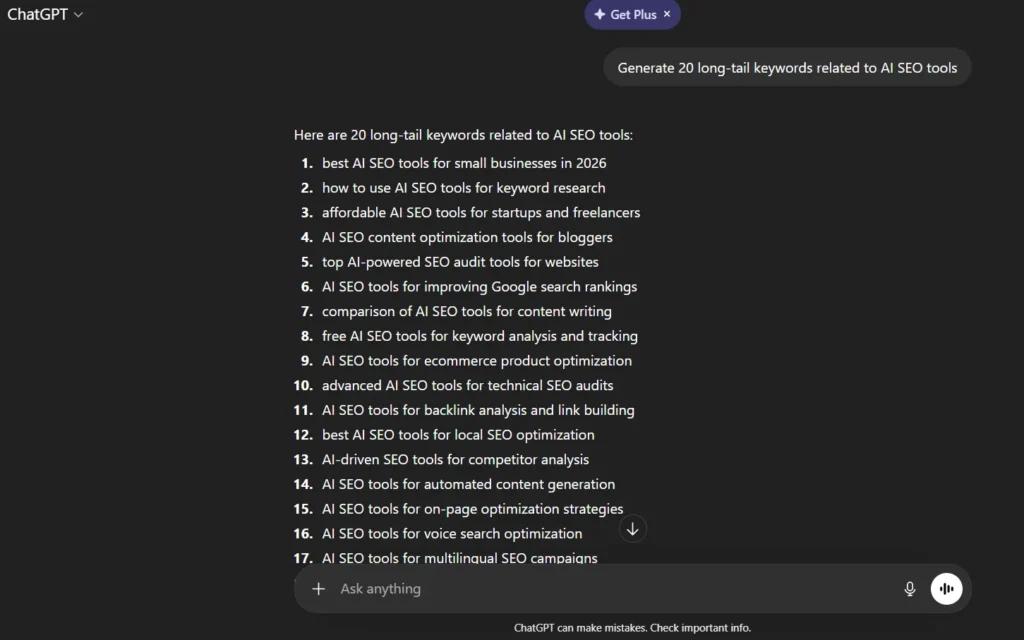
can instantly provide ideas you may not have considered.
That said, ChatGPT should not replace keyword research platforms. Tools like Ahrefs or Semrush still provide critical data such as search volume and keyword difficulty.
Think of ChatGPT as a keyword brainstorming engine, while traditional SEO tools provide the data to validate those ideas.
2. Build Content Around Topic Clusters
One of the biggest shifts in modern SEO is the move from individual keywords to topic clusters.
Search engines increasingly reward websites that demonstrate authority on a topic rather than targeting isolated keywords. This means creating multiple related pieces of content that connect through internal links.
ChatGPT can make this process significantly easier.
For instance, after generating a list of keywords, you can ask ChatGPT to organize them into clusters based on similar topics. This helps you identify which articles should support a broader pillar page.
If your main topic is “AI SEO,” ChatGPT might group keywords into clusters such as AI keyword research, AI content optimization, and AI SEO tools.
This structure allows you to create a content ecosystem, where multiple articles reinforce each other and strengthen your authority on the subject.
3. Identify Search Intent Behind Keywords
Understanding search intent is one of the most important skills in SEO. Even if you target the right keyword, your content will struggle to rank if it doesn’t match what users are actually looking for.
ChatGPT can help analyze the likely intent behind a keyword.
For example, the keyword “best SEO tools for small business” likely indicates commercial investigation. Users searching for it are comparing tools before making a purchase decision.
On the other hand, a search like “what is SEO” suggests informational intent.
By identifying these patterns, ChatGPT helps you determine whether your content should be a tutorial, product comparison, or detailed guide.
When your content aligns with user intent, search engines are much more likely to rank it.
4. Generate High-Quality Content Ideas
Coming up with fresh content ideas can be surprisingly difficult, especially if you publish regularly.
ChatGPT solves this problem by acting as a brainstorming partner.
Instead of staring at a blank document, you can ask it to generate blog ideas around a specific topic or industry. In seconds, you’ll have a list of potential articles you can expand into full pieces of content.
This is particularly useful when building a long-term content strategy.
For example, if your website focuses on AI and marketing, ChatGPT can suggest dozens of related topics such as AI keyword research strategies, AI content optimization tips, and case studies on AI-driven SEO campaigns.
These ideas can then be prioritized based on keyword research and search demand.
5. Create Detailed SEO Content Outlines
Before writing any article, experienced marketers start with an outline. A well-structured outline ensures that your content covers all relevant subtopics and answers the reader’s questions clearly.
ChatGPT can generate detailed outlines that include logical headings and subheadings.
However, the real value comes when you guide the AI with specific instructions. For example, you might ask it to create an outline that targets beginners, or one designed for advanced SEO professionals.
This type of prompt helps the AI tailor the structure of the article more effectively.
Once the outline is generated, you can refine it further based on your expertise and SEO research.
6. Draft SEO-Optimized Content
Perhaps the most obvious use case for ChatGPT is content writing.
When used correctly, it can help you draft introductions, explain complex ideas, or expand on specific sections of an article.
However, relying entirely on AI-generated content is not recommended. Search engines prioritize content that demonstrates experience and expertise.
Instead, think of ChatGPT as a starting point. It can generate an initial draft that you then refine, expand, and personalize with your own insights.
This approach dramatically reduces writing time while still maintaining quality.
Check out the Best AI Tools for Writing SEO Rich Blog Content.
7. Write Meta Titles and Descriptions
Meta titles and descriptions may seem like small details, but they have a significant impact on click-through rates.
A compelling title can determine whether someone clicks your result or scrolls past it.
ChatGPT can quickly generate multiple variations of meta titles and descriptions based on your target keyword. You can then test different options and choose the one that best captures the searcher’s attention.
Because AI can produce several variations instantly, it becomes easier to experiment with different messaging styles.
8. Create FAQ Sections to Capture More Search Traffic
Many search results now include People Also Ask questions. These are additional queries related to the main topic that users frequently search for.
Including an FAQ section in your content increases the chances of ranking for these queries.
ChatGPT can generate relevant questions that people might ask about your topic. You can then expand these questions into detailed answers within your article.
This not only improves SEO but also enhances the reader experience by addressing common concerns directly.
9. Improve Existing Content
SEO isn’t only about publishing new articles. In fact, updating existing content often delivers faster ranking improvements.
ChatGPT can analyze paragraphs and suggest ways to improve readability, clarity, or depth.
For example, you can ask it to simplify complex explanations or expand on thin sections that need more detail.
This makes it a valuable tool for content refresh strategies, which are increasingly important for maintaining search rankings.
10. Discover Internal Linking Opportunities
Internal links help search engines understand how pages on your website relate to each other.
They also guide readers to additional useful content, increasing time spent on your site.
ChatGPT can help identify logical connections between articles and suggest where internal links might fit naturally within the text.
While you still need to verify the relevance of each link, the AI can speed up the discovery process considerably.
11. Write Backlink Outreach Emails
Building backlinks remains one of the most challenging aspects of SEO.
Reaching out to other websites for guest posts or mentions often requires sending personalized emails, which can quickly become time-consuming.
ChatGPT can draft outreach templates that you can customize for different opportunities. With the right prompt, it can create polite and persuasive messages that highlight the value of your content.
You still need to personalize the email for each recipient, but the AI removes much of the repetitive writing involved.
12. Generate Schema Markup
Structured data helps search engines better understand your content. It can also improve your chances of appearing in rich search results.
ChatGPT can generate basic schema markup for elements such as FAQs, articles, or how-to guides.
While you should still test the markup before implementing it, this feature can save time for marketers who aren’t familiar with coding.
Best Practices When Using ChatGPT for SEO
Although ChatGPT is incredibly useful, it’s important to use it responsibly.
First, always verify important information. AI-generated content can sometimes include inaccuracies, so fact-checking remains essential.
Second, combine ChatGPT with traditional SEO tools rather than replacing them. Data-driven insights are still necessary for making strategic decisions.
Finally, remember that your expertise is what makes the content truly valuable. AI can help with structure and efficiency, but your experience and insights are what build trust with readers.
The Future of AI in SEO
AI is rapidly becoming part of the SEO workflow, and tools like ChatGPT are only the beginning.
As AI models improve, they will likely assist with deeper search intent analysis, automated content optimization, and predictive SEO insights.
However, one thing will remain constant: the importance of human creativity and strategic thinking.
The marketers who succeed in the future will not be those who rely entirely on AI, but those who learn how to combine AI efficiency with human expertise.