
Search is changing faster than ever. With the rise of artificial intelligence, most users will get answers before they even click on a website. AI models like Google’s Search Generative Experience (SGE), ChatGPT, and Perplexity now show instant summaries, product suggestions, and explanations right inside search results.
This means one thing:
Traditional SEO is no longer enough.
To stay visible in AI-powered search, you must shift from old-school keyword tactics to a smarter strategy built around topical authority, AI-friendly structure, and strong credibility signals.
This guide breaks down five clear, actionable strategies to help you dominate modern search using AI SEO, also known as AI-powered search optimization, AI-driven SEO, and machine learning SEO tactics.
What is AI SEO and Why Is It Significant?
AI SEO is the practice of optimizing your website and content so AI search engines and AI assistants can understand, trust, cite, and recommend you.
Unlike traditional SEO, which mainly focuses on ranking in Google’s blue links, AI SEO focuses on visibility inside AI-generated summaries, answer boxes, and conversational search experiences.
Gartner predicts that by 2026, AI assistants and large language models will manage about 25% of all search queries worldwide, taking over many conventional search behaviors. This changes everything:
- Traffic will drop for many traditional keywords.
- Being “ranked #1” will matter less.
- Getting cited or referenced by AI will matter more.
- Conversions will rise from AI summaries because they attract high-intent users.
In short, AI SEO is no longer optional; it is essential for future-proof visibility.
Difference Between Traditional SEO and AI SEO
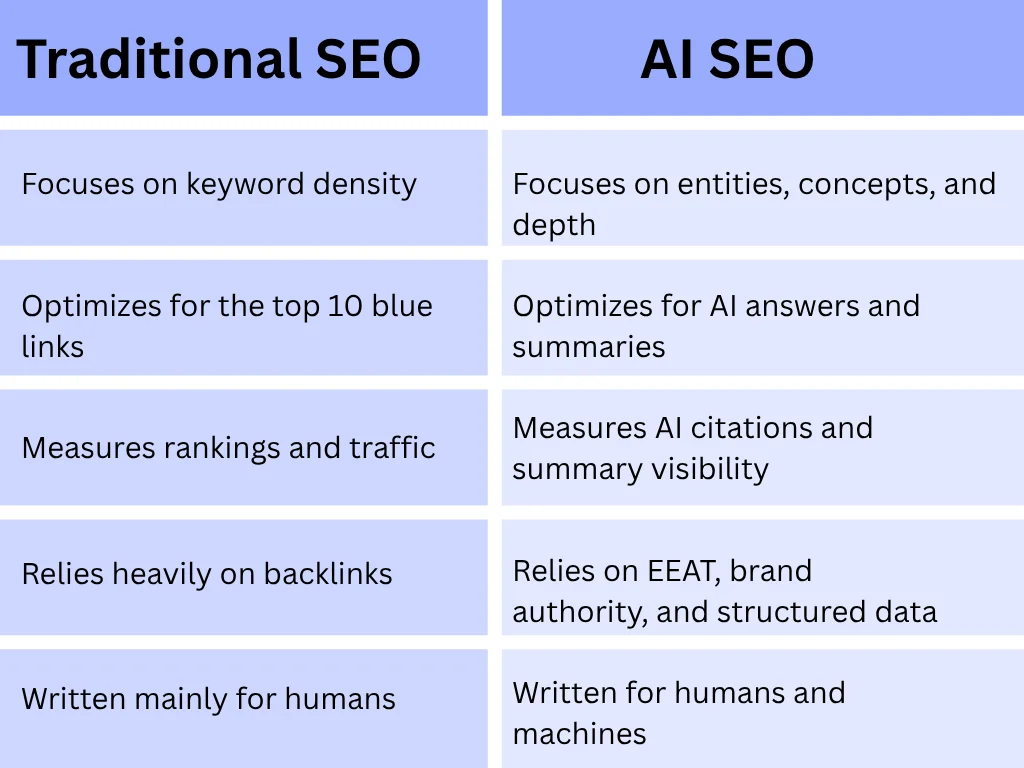
Traditional SEO tried to win the ranking race. AI SEO tries to win the relevance race. This new world belongs to websites that show expertise, topical authority, and machine-readable clarity.
How AI Has Changed Search Engine Optimization
AI didn’t just tweak search; it rewired it.
Search engines now use:
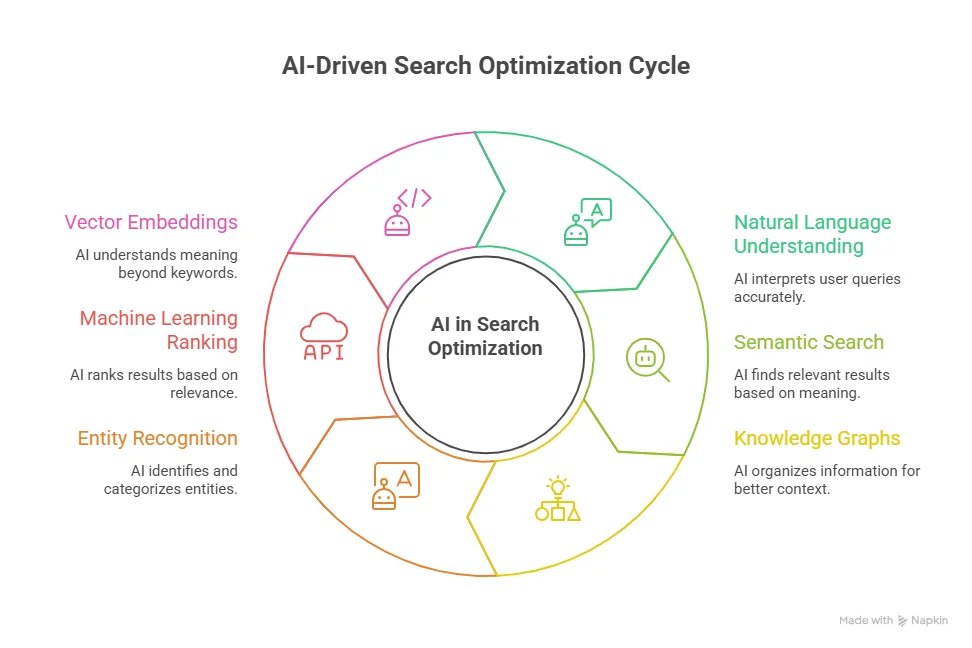
Because of this, AI-driven search engines look for:
- Depth
- Accuracy
- Clarity
- Authority
- Credibility
- Explicit data
Hence, blogs with strong topical coverage and high entity relevance are cited more often inside AI answers. It’s also why brand authority and author credentials now directly influence visibility.
Let’s explore the five strategies that matter most to dominate AI SEO.
1. Topical Authority and Semantic Variety Surpass Keyword Density
AI no longer rewards pages stuffed with the same keyword over and over. Instead, it rewards pages that show true understanding of a topic.
That’s where topical authority and semantic variety come in. This is the heart of modern AI SEO.
Build Topical Depth: Create One Central Pillar Page
To dominate AI-powered search, create one main pillar page that covers a topic deeply. Then support it with clusters of related subpages.
For example, a pillar page called “AI SEO Complete Guide” can be supported by topics like AI content optimization, Entity SEO, Knowledge graphs, Semantic search, and more to build expertise.
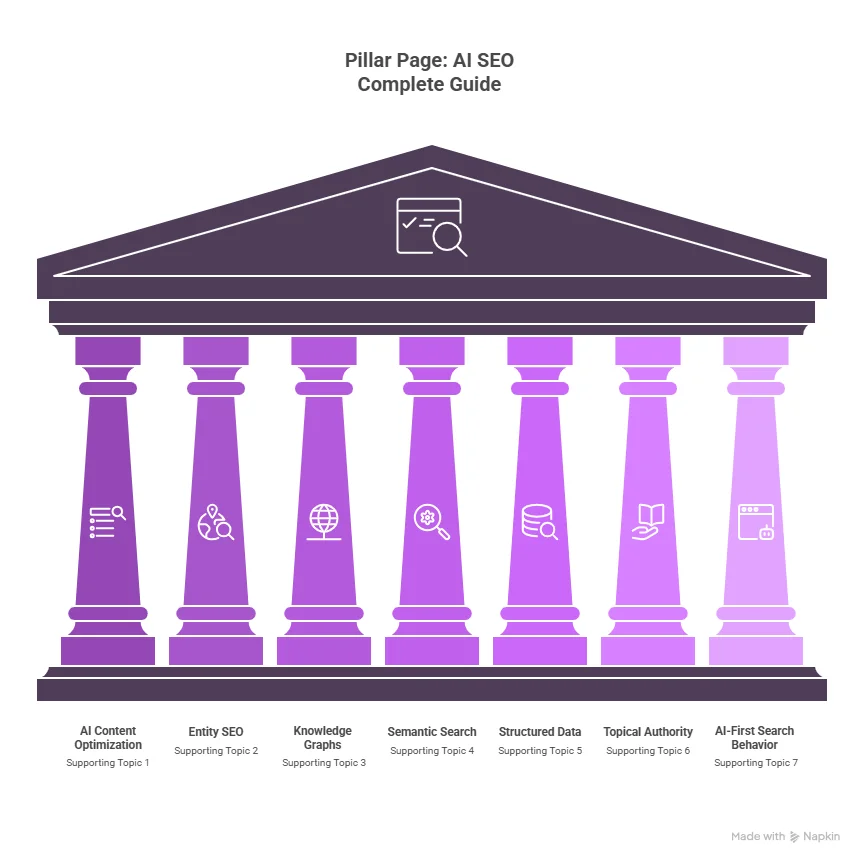
This structure tells AI: “This brand knows this topic inside out.” Search engines love this because their goal is to deliver expert-level, trustworthy content.
Why topical depth matters:
- AI models use entity recognition to evaluate expertise.
- Deep coverage builds authority in knowledge graphs.
- It increases your chances of getting cited in summaries.
- It boosts your visibility in People Also Ask, featured snippets, and conversational answers.
Use Semantic Variety
You can say the same thing in different ways. For instance:
The car was fast.
The vehicle moved quickly.
The automobile had high speed.
All three sentences describe the same idea, but each uses different wording, which is a semantic variation.
Modern AI search systems understand concepts, not just exact keywords. They look for semantic variety to confirm that your content fully covers a topic from multiple angles.
Americans typically say “faucet,” while British speakers usually say “tap.”
Because different regions use different terms for the same thing, semantic variety helps your content reach a wider audience. AI systems are more likely to interpret your content as comprehensive and globally relevant, increasing your chances of appearing in more AI-generated search answers.
Additionally, using natural variations like synonyms, related phrases, and rephrased questions helps AI:
- Interpret your page as comprehensive,
- Match more diverse user queries,
- Increase your chances of ranking in AI-generated answers.
Tools like Surfer SEO, Google NLP API, and Topic modeling tools help you see the entities, related keywords, and concepts connected to your topic. This makes your content more understandable not only to people but also to AI models.
Check out the comprehensive list of top 10 AI SEO tools for writing SEO rich blog content put together by yours truly.
2. Build Author and Brand Authority (EEAT) for AI
In the AI era, your content is only as good as your credibility.
Google and AI models deeply evaluate:
- Experience
- Expertise
- Authority
- Trustworthiness
This is known as EEAT. The stronger your EEAT footprint, the more AI trusts and cites you.
Show Your Experience
Add:
- Clear author bios
- Credentials
- Work experience
- Case studies
- Firsthand stories
- Industry examples
AI platforms prefer citing real people with real experience. Your author page becomes a trust badge.
Earn Brand Mentions (Even Unlinked)
AI systems learn from:
- Brand mentions
- Podcast appearances
- Guest posts
- Interviews
- News features
- Social media discussions
Moreover, even unlinked mentions strengthen your entity footprint. It boosts brand authority, which helps AI models choose your content in answers.
Be Consistent Across Every Platform
Consistency signals trust. So make sure your:
- Name
- Bio
- Tone
- Expertise
- Brand message
… is aligned everywhere.
AI uses pattern recognition. When your identity is consistent, AI sees you as a reliable source.
3. Optimize for Featured and Summarized Results
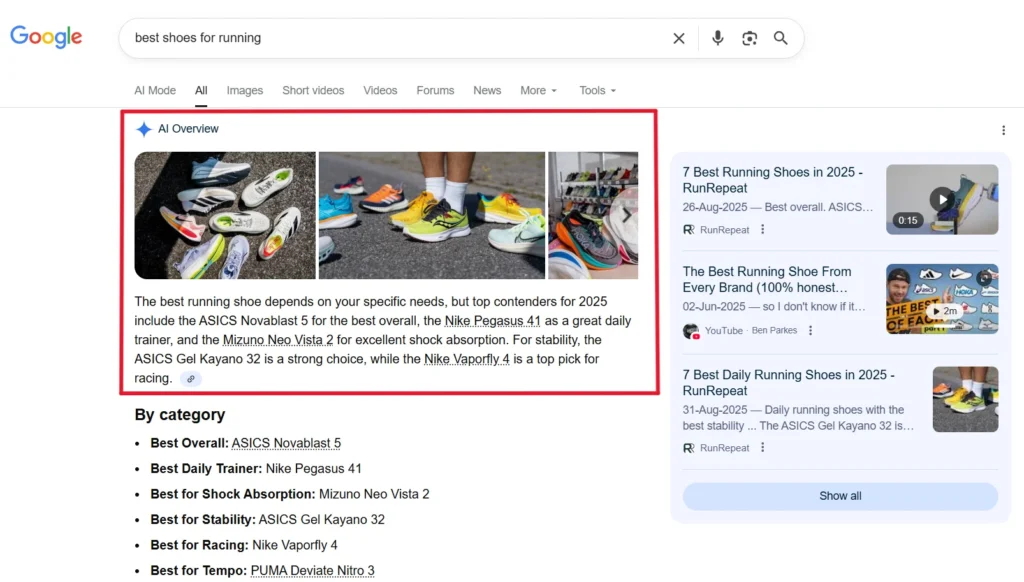
In AI-first search, the summary is the new first page of Google. It has produced a new concept called AEO or Answer Engine Optimization. Here’s how to get featured.
Write Like You’re Answering a Question
AI models love direct answers. Begin sections with short, clear statements.
For example: “AI SEO is the process of optimizing your content for AI-driven search engines and AI-generated summaries.”
This format increases your chance of being quoted.
Structure for Scanners
Use:
- Short paragraphs
- Clear subheadings
- Bullet points
- Numbered lists
- Simple wording
AI reads similarly to humans; it scans. Structured content increases citation probability.
Target “People Also Ask”
After the invention of generative tools like ChatGPT, Perplexity, or Claude, people tend to ask straight questions that are nuanced and specific. Therefore, curate your content considering the commonly asked questions about a particular topic.
In addition, develop your content in a conversational tone and be precise and to the point so that your answers get featured in the AI overviews and snippets.
Always add a frequently asked questions section in your blogs or articles, such as:
- What is AI SEO?
- How does AI change SEO?
- Is AI SEO better than traditional SEO?
It increases your chances of AI visibility. If you struggle to find questions or queries related to your topic, use Also Asked or Answer the Public to discover connected questions users are searching for around the subject.
4. Feed the Machines Structured Data and AI-Friendly Content
If topical authority is the body of your SEO strategy, structured data is the skeleton. AI models love clarity.
Use Schema Markup
Add schema like:
- FAQ Schema
- How-To Schema
- Review Schema
- Article Schema
- Organization Schema
- Author Schema
A schema acts like a nutrition label for AI. It tells machines exactly what your content represents. Modern-day SEO plugins like YoastSEO or RankMath have made inputting schema ever so easy. Moreover, you can just develop them using ChatGPT.
Add Multiple Formats
AI prefers multimodal content. This means mixing: videos, images, infographics, charts, or even audio snippets. Multimodal signals show depth, clarity, and expertise.
In 2025, 83% of consumers want to see more video content from brands, which goes to show the importance of multimodal content marketing.
In addition, using various modes of content signals trust, expertise, and authoritativeness to the Search Engine’s algorithm. You don’t even need to worry about creating interesting animations anymore, thanks to AI Video generation models.
Check out this comprehensive blog on the top AI Video Generations models of 2025 and create exciting animations to integrate into your content.
Make Your Data Explicit
Never hide value inside long paragraphs. Instead, use:
- Tables
- Stats
- Quote boxes
- Numbered insights
- Definitions
AI extracts data more easily when it’s explicit.
This helps your content appear inside:
- Answer boxes
- Product overviews
- Recommendation summaries
- Comparison tables
Highlighting the key information within your blog using bullet points, tables, or stats is the surest way to stand out and quite an easier one too.
5. Rethink Your SEO Workflow for Generative Search
AI SEO isn’t a one-time checklist. It’s a continuous workflow.
Here’s how to evolve your process.
Add “AI Visibility” Metrics to Your Reports
Instead of just tracking rankings, also measure:
- How often your site appears in AI summaries
- Whether AI cites your brand
- Whether your frameworks or content patterns appear in answers
- How your content is paraphrased by AI systems
AI citation is the new SEO KPI.
Test Your Summaries
Take your link and paste it into:
- ChatGPT
- Perplexity
- Claude
- Gemini
Ask the model:
“Summarize this article.”
If your summary:
- Misses key points
- Sounds inaccurate
- Leaves out your main arguments
…then your content needs more clarity. Rewrite it until AI captures your message correctly.
Build Recognizable Patterns
AI learns from repetition. So give it patterns.
Create:
- Unique frameworks
- Custom terms
- Signature steps
- Branded visuals
- Distinct writing style
These become “AI hooks.” Over time, the machine recognizes them as yours.
Advantages of AI SEO
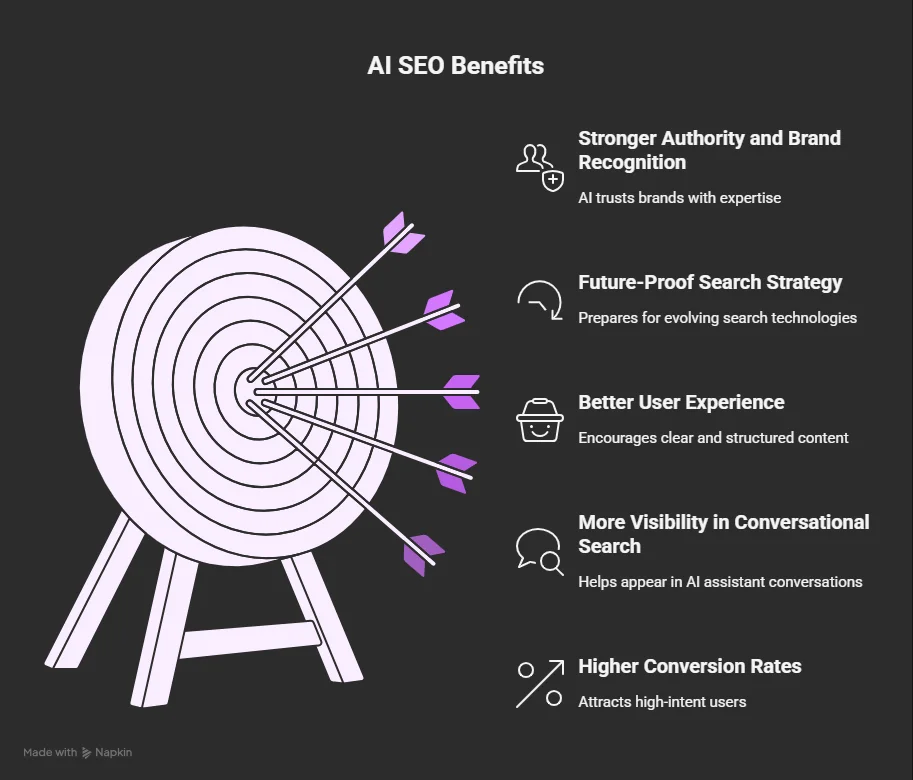
AI SEO gives you a major edge, even as search evolves.
1. Higher Conversion Rates: AI answers attract high-intent users. Many businesses see 10%+ increases in conversions from AI-driven traffic.
2. More Visibility in Conversational Search: AI assistants are becoming the new search engines. AI SEO helps you appear inside these conversations.
3. Better User Experience: AI SEO encourages clear content, simple language, structured pages, and helpful formatting. This improves your user experience as well.
4. Future-Proof Search Strategy: AI SEO prepares your brand for Zero-click search, AI-first engines, Multimodal search, and Agent-based assistants
5. Stronger Authority and Brand Recognition: Lastly, AI trusts brands with clear expertise and consistent patterns. The stronger your entity footprint, the more AI cites you.
Final Thoughts
Search is entering a new era. AI doesn’t reward shortcuts or keyword tricks. It rewards expertise, clarity, structure, and depth. If you want to dominate AI-powered search, focus on building:
- Topical authority
- Strong semantic coverage
- EEAT consistency
- AI-friendly data structures
- Recognizable content patterns
- New AI visibility metrics
Brands that adapt early will lead the future. Brands that resist will fall behind.
The good news? You now have the roadmap to win.
FAQs
1. What is AI SEO?
AI SEO is the process of optimizing content so AI search engines and AI assistants can understand, trust, and cite it.
2. Is AI replacing SEO?
No. SEO is evolving, not disappearing. AI SEO requires strategy, consistency, and strong authority signals.
3. Do keywords still matter?
Yes, but only when used naturally. Topical depth and semantic variety matter more.
4. How do I get my content cited in AI summaries?
Focus on:
- Clear answers
- Structured data
- Expertise
- Brand mentions
- Deep topical coverage
5. Does blogging still work in the AI era?
Absolutely. Blogs are the top content type cited by AI models like ChatGPT and Perplexity.
1 thought on “AI SEO: 5 Actionable Strategies to Dominate AI-Powered Search”