
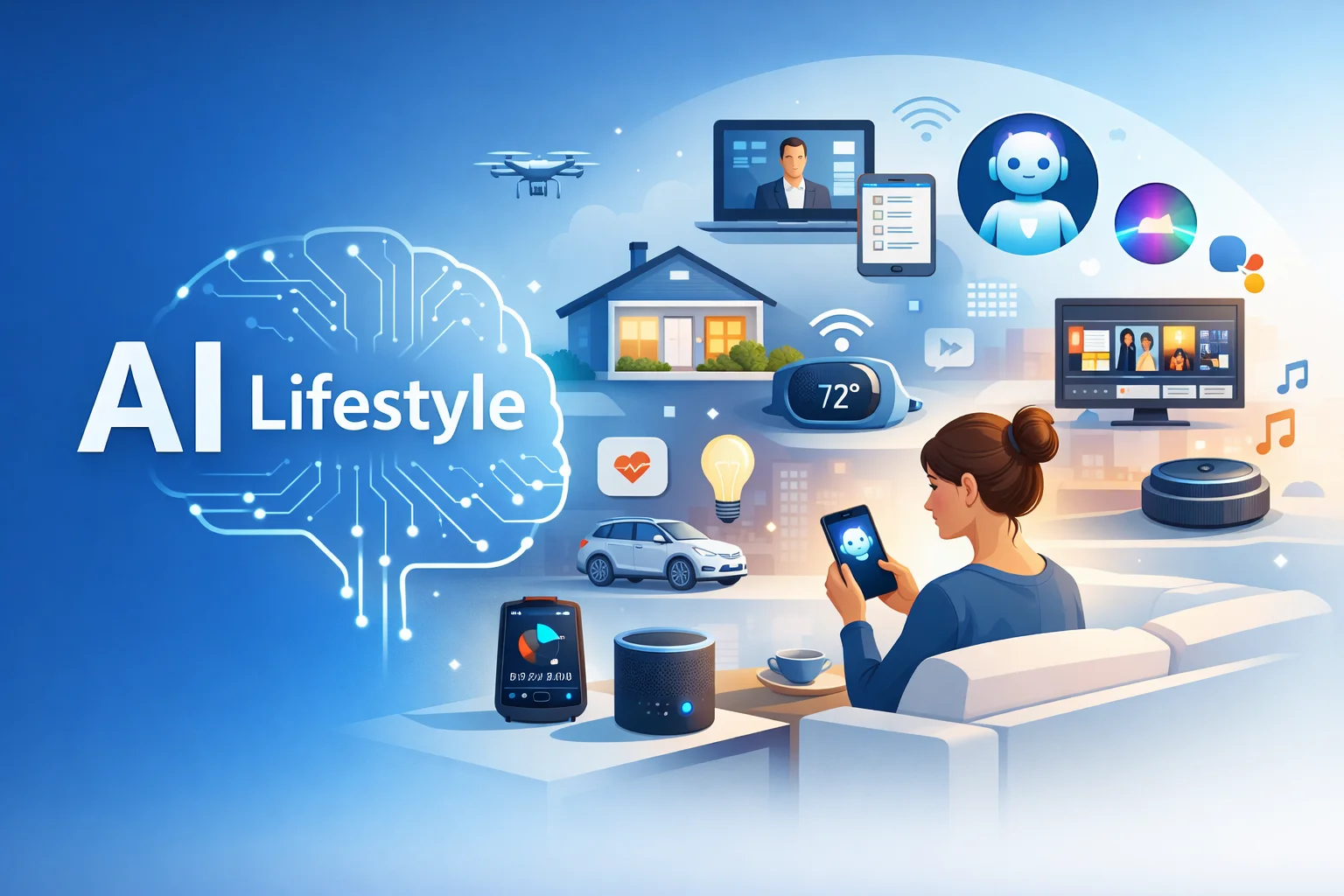
Artificial intelligence is no longer a future concept or a tech buzzword. It has become part of how you live your everyday life. You may not see it clearly, but AI already influences how you wake up, what you watch, how you work, and even how you relax.
This growing integration of AI into everyday routines is known as AI Lifestyle. It refers to the way artificial intelligence tools, systems, and services quietly shape daily habits, decisions, and environments without demanding constant attention. You are not living a sci-fi life. You are living an assisted one.
What Does AI Lifestyle Actually Mean?
An AI lifestyle means using artificial intelligence to support, guide, and optimize daily life. Instead of manually handling every small task or decision, you rely on intelligent systems to reduce effort and improve efficiency.
AI does three core things in lifestyle design:
- Observes behavior
- Learns patterns
- Adjusts outcomes
For example, tools like ChatGPT help you think, plan, and write faster. Apple’s Siri, Google Assistant, and Amazon Alexa help manage reminders, schedules, and quick actions. Smart systems do not replace your judgment, but they reduce friction across your day. A helpful way to see the AI lifestyle is this. You make the big decisions. AI smooths the small ones.
How AI Quietly Became Part of Everyday Life
AI did not arrive suddenly. It entered daily life slowly and blended in so well that most people stopped noticing it. Early AI handled basic tasks like spam filtering or spell correction. Over time, it moved into recommendations, predictions, and automation.
Today, AI systems manage parts of life in the background. They adjust without asking, learn without interrupting, and improve quietly. This is why many people underestimate how much AI already influences their lifestyle.
Over half of U.S. adults have used AI in the last six months, and almost one in five use it on a daily basis. On a global scale, that means roughly 1.7 to 1.8 billion people have tried AI tools, with around 500 to 600 million using them every day.
AI lifestyle changes feel normal because they grow gradually. Just like electricity or the internet, they fade into the background once they work well.
AI in Your Daily Routine
AI often starts working before you consciously do. Your smartphone alarm adapts to sleep data. Your weather app highlights conditions relevant to your schedule. Your calendar prioritizes meetings based on urgency.
Tools like Apple Health, Google Calendar, and Microsoft Outlook Copilot analyze usage patterns to reduce mental load. Instead of managing every reminder manually, you let systems guide the flow of your day. This does not make life perfect. However, it makes it smoother.
How AI Shapes What You Watch, Read, and Hear
AI plays a major role in content consumption. Platforms like YouTube, Netflix, Spotify, Instagram, and TikTok rely heavily on recommendation algorithms.
You still choose what to click, but AI decides what appears first. It tracks viewing time, engagement, skips, and preferences. Over time, it builds a detailed understanding of what keeps your attention.
According to Netflix, over 80 percent of watched content comes from AI-driven recommendations. This shows how strongly AI influences entertainment choices, often without direct awareness.
Additionally, AI acts like a personal curator. It filters the noise and highlights what it believes matches your taste, for better or worse.
AI at Work and Personal Productivity
AI lifestyle extends deeply into how you work. Tools like Notion AI, Google Workspace AI, ChatGPT, and Microsoft Copilot help with writing, summarizing, planning, and decision-making.
Email systems filter messages automatically. Task managers suggest priorities. AI tools draft content and organize ideas.
Instead of spending energy on repetitive tasks, you focus on thinking and creativity. Moreover, when used intentionally, AI improves output without removing human control.
For many professionals, AI already feels like an invisible assistant handling the background work.
AI in Health, Wellness, and Self-Care
AI is also shaping how people manage health and wellness. Wearables like Apple Watch, Fitbit, and Oura Ring use AI to analyze sleep, movement, heart rate, and recovery patterns.
Wellness apps turn raw data into simple guidance. They suggest rest, movement, or habit changes.
According to the World Economic Forum, AI-powered health monitoring tools have improved early detection and daily health awareness for millions of users globally. While these tools do not replace doctors, they help people make more informed lifestyle choices.
In short, AI simplifies self-care by translating data into action.
AI Inside the Modern Home
Smart homes are a clear example of AI lifestyle in action. Devices like Google Nest, Amazon Echo, Apple HomeKit, and Philips Hue use AI to adapt environments automatically.
Lighting adjusts based on usage. Thermostats learn comfort preferences. Lastly, Security systems detect unusual behavior.
Over time, homes respond instead of waiting for commands. This reduces manual effort and creates a more intuitive living experience.
AI turns homes from static spaces into adaptive ones.
Core Areas AI Touches Daily
An AI lifestyle is easiest to understand when broken into key areas:
- Communication, tools like ChatGPT, Gmail AI, Siri
- Entertainment, platforms like Netflix, Spotify, YouTube
- Productivity, tools like Notion AI, Copilot, and Google AI
- Health, wearables, and wellness apps
- Home, smart assistants, and automation systems
These areas cover most daily interactions with technology.
Does AI Lifestyle Mean Losing Control?
This is a valid concern. AI influences decisions, but it does not force them. Most systems suggest options rather than dictate outcomes.
The risk appears when people stop questioning suggestions. Convenience can slowly replace intention if awareness disappears. Therefore, an AI lifestyle works best when you stay conscious and selective.
AI should act like a guide, not an authority. Just like navigation apps, it helps, but you choose the route.
Why AI Lifestyle Will Matter Even More Going Forward
AI systems are becoming more personalized and proactive. They will continue moving from tools to companions that support daily life in deeper ways.
Understanding AI lifestyle early allows you to shape how you use it. Instead of reacting to automation, you learn to design routines that feel efficient, balanced, and human. AI is not replacing life. It is redesigning how life flows.