
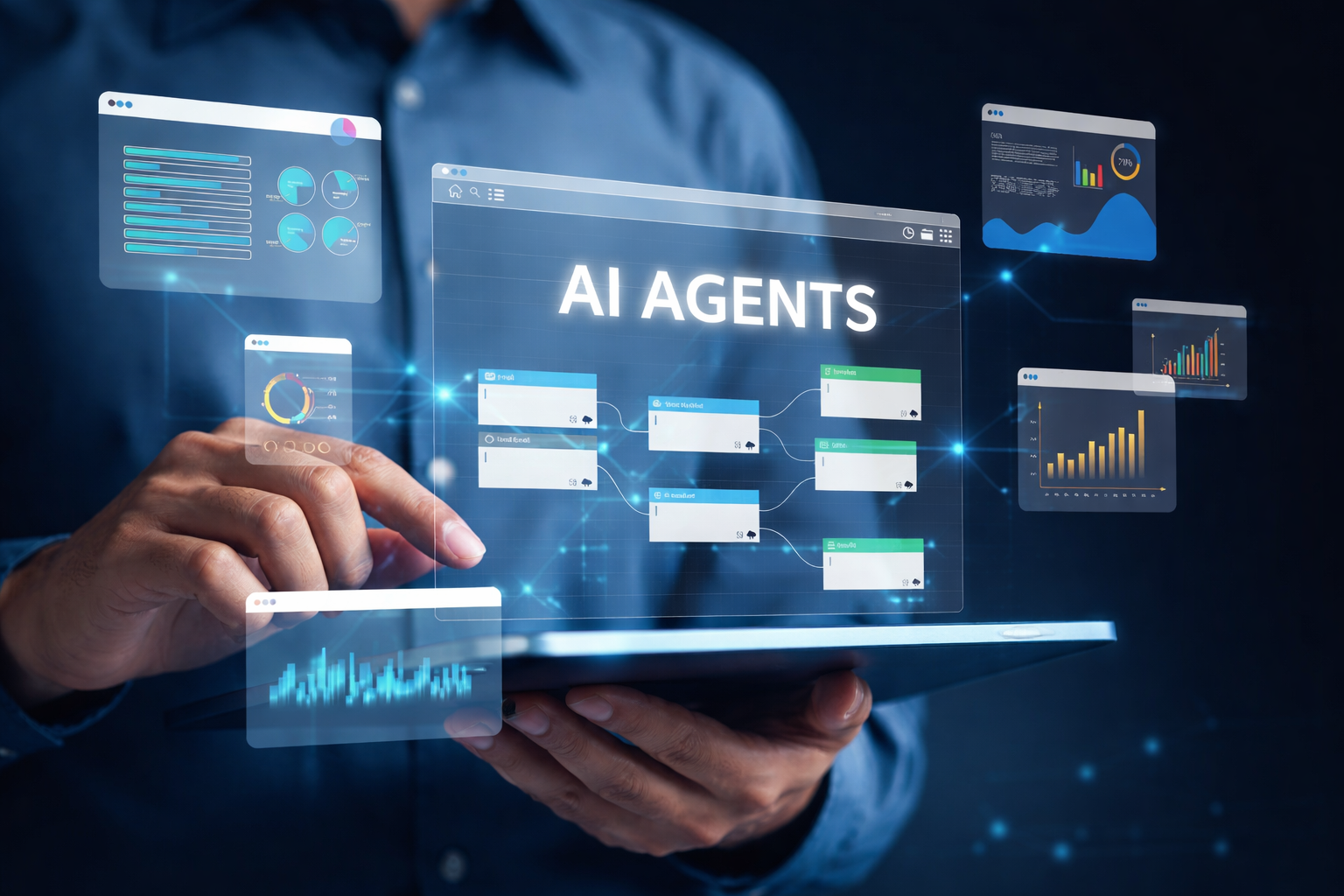
As enterprises move into 2026, a clear shift is underway. Artificial intelligence is no longer limited to experimentation or isolated pilots. Instead, it is becoming deeply embedded in how organizations operate, compete, and grow. At the center of this shift are AI agents, which are rapidly evolving from helpful assistants into autonomous digital workers capable of managing complex tasks end-to-end.
However, AI agents are only one part of a much bigger picture. Around them, a new set of technologies is emerging, reshaping enterprise strategy, security, infrastructure, and sustainability. Together, these trends signal a move away from hype and toward real, measurable business value.
Let’s explore the 10 key tech trends that will reshape enterprises in 2026, with AI agents acting as the anchor that connects them all.
1. Agentic AI Platforms
AI agents represent the next major step beyond traditional chatbots and single-task automation tools. Unlike earlier AI systems, agents can reason, plan, and act across multiple steps. They can interact with software tools, trigger workflows, and adapt based on real-time feedback.
In 2026, agentic AI platforms will allow enterprises to deploy these agents at scale. Low-code and no-code interfaces will make it easier for teams to design agent-driven workflows, while governance layers will help manage compliance, ethics, and accountability. As a result, organizations will begin treating AI agents as digital coworkers rather than tools.
2. Generative AI Copilots Everywhere
Generative AI copilots are quickly becoming a standard feature across enterprise applications. From writing code and summarizing meetings to drafting legal documents and creating project plans, copilots are enhancing productivity across roles.
Rather than replacing employees, these systems augment human expertise. In 2026, copilots will be deeply embedded into workplace software, reducing cognitive load and speeding up decision-making. Over time, they will become invisible yet indispensable parts of daily work.
3. Industry-Specific Cloud Platforms
Generic cloud solutions are no longer enough for many enterprises. As industries face unique regulatory, operational, and data challenges, industry cloud platforms are gaining momentum. Gartner expects that by the end of 2026, around 70% of enterprises will be using industry cloud platforms, a sharp rise from less than 15% adoption in 2023.
These platforms combine infrastructure, applications, and data models tailored to specific sectors such as healthcare, finance, manufacturing, and life sciences. Resultantly, industry clouds will provide faster deployment, built-in compliance, and better integration with AI systems, giving enterprises a clear competitive advantage.
4. Enterprise Quantum Readiness
Quantum computing is still emerging, but its impact on enterprises can no longer be ignored. On one hand, quantum systems promise breakthroughs in areas like logistics optimization, financial modeling, and drug discovery.
On the other hand, quantum computing poses a serious threat to current encryption standards. As a result, quantum readiness is becoming a strategic priority. 2026 could be the year when enterprises will begin transitioning toward quantum-safe encryption to protect sensitive data and future-proof their security infrastructure.
5. Zero-Trust Security at the Edge
The rise of remote work, cloud services, and connected devices has expanded the enterprise attack surface. Traditional perimeter-based security models are no longer effective.
As 72% of organizations have already adopted or are planning to implement zero-trust models, security efforts are shifting toward validating identity and access permissions exactly where data is generated and accessed. This approach verifies every user, device, and request, regardless of location. This year, zero-trust edge frameworks will deliver real-time protection directly where data is created and accessed, reducing risk while maintaining performance.
6. Extended Reality for Enterprise Operations
Extended reality (XR), which includes virtual reality and augmented reality, is finally moving beyond experimentation. Improvements in hardware, such as lighter headsets and smart glasses, are driving real enterprise adoption.
This year, XR will be widely used for immersive training, remote expert support, and hands-free access to information in complex environments. The XR market is projected to reach $380 billion by 2036. These applications will improve safety, reduce downtime, and accelerate skill development across industries.
7. Digital Twins at Organizational Scale
Digital twins are evolving rapidly. What started as simulations of machines or systems is now expanding into models of entire processes, facilities, and even organizations.
Additionally, by integrating real-time data with AI-driven insights, digital twins enable predictive decision-making. Enterprises will use digital twins to test strategies, optimize workflows, and prevent failures before they happen, all without real-world risk or cost.
8. Sustainable and Green-by-Design Technology
Sustainability is no longer optional. Regulatory requirements and stakeholder expectations are forcing enterprises to rethink how technology impacts the environment.
In addition, Sustainability will be built into enterprise systems by design. This includes energy-efficient software, carbon-aware cloud workloads, and AI-powered monitoring tools that track environmental impact. Ultimately, Enterprises that align sustainability with innovation will gain both regulatory compliance and long-term resilience.
9. Autonomous Operations and Intelligent Automation
Automation is shifting from task-level scripts to fully autonomous operations. Powered by AI agents, enterprises are beginning to automate entire business processes, from supply chain management to IT operations.
Moreover, intelligent automation systems will monitor performance, detect anomalies, and take corrective action with minimal human input. This shift will reduce operational costs while improving speed and reliability across the enterprise.
10. Responsible AI Governance and Ethics
As AI systems gain more autonomy, governance becomes critical. Enterprises must ensure transparency, fairness, and accountability in how AI makes decisions.
In 2026, responsible AI frameworks will move from policy documents to operational systems. This includes continuous monitoring, bias detection, explainability tools, and clear human oversight. In the end, organizations that invest early in ethical guardrails will build trust with customers, employees, and regulators.
Final Thoughts
The enterprise technology landscape of 2026 is not defined by a single innovation, but by how these technologies work together. AI agents anchor this transformation, connecting cloud platforms, automation systems, security frameworks, and digital twins into a unified enterprise fabric.
However, success will not come from technology alone. Leaders must also address skills gaps, manage organizational change, and ensure ethical use of AI. Those who focus on practical value rather than hype will be best positioned to thrive.
In 2026, the enterprises that win will be the ones that turn intelligence into action—and action into lasting advantage.